
Make Cordage (Plant Fibers)
Last edited · 92a9d6f · tewelde
Summary
Cordage (string/rope) is a force-multiplier: it enables binding, carrying, traps, fishing lines, bows, shelters, and many other tools. You can make usable cordage at Level 0 by processing natural fibers and twisting them into a 2‑ply reverse-wrap.
Terms used in this article
- Bast — the fibrous inner bark layer of some trees and shrubs, between the rough outer bark and the wood; it peels off in long tough strips.
- Pith — the soft, spongy core inside many plant stems; too weak for cordage, so it is removed.
- Ply — one twisted strand; a 2‑ply cord is two strands wrapped around each other.
- Splice — joining new fibers into a strand by overlapping and twisting them together (step 4 below).
- Braid — interweaving three or more strands by passing the outer strands alternately over the middle, like braiding hair.
Prerequisites
- None (Level 0).
Diagram
Materials
- Fiber source: long, tough plant fibers. Options include:
- Inner bark (bast) from some trees/shrubs
- Fibrous stems (nettles, dogbane, milkweed relatives)
- Long grasses or reeds (usually weaker, but usable)
- Clean water (optional but helpful for soaking/softening fibers)
You do not need a cutting tool if you can tear/split fibers by hand, but a sharp stone edge makes it easier.
Steps
1) Harvest and sort fibers
- Collect a bundle of long fibers (longer is easier to twist).
- Remove leaves, pith, and brittle outer layers.
- Sort: keep the longest fibers for the main line, shorter fibers for splicing.
Goal: fibers that bend without snapping when you pull them gently.
2) Dry or dampen (depending on the fiber)
- Some fibers twist best slightly damp (less brittle).
- Some bark fibers need soaking to separate and soften.
If fibers snap while twisting, dampen them. If they stretch and get mushy, dry them a bit.
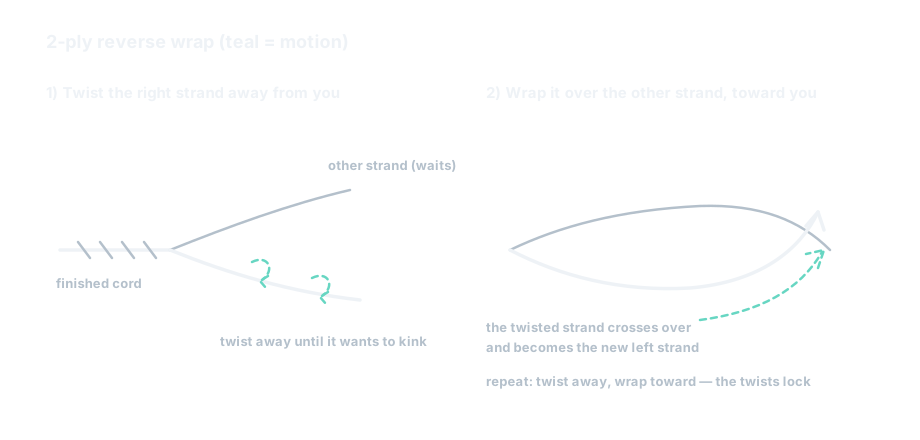
3) Make a 2‑ply reverse-wrap
This is the core technique: twist each strand in one direction, then wrap the two strands around each other in the opposite direction. The opposing twists lock.
- Split your fiber bundle into two equal strands.
- Twist the right strand away from you until it wants to kink.
- Hold that twist, then wrap the right strand over the left strand (toward you).
- Repeat: twist the new right strand away from you, then wrap it over.
Keep steady tension so the cord stays even.
4) Splice in new fiber (to make a long line)
- Before a strand runs out, lay a new bundle of fibers overlapping the thinning strand by a palm-width or more.
- Twist the old + new fibers together as if they were one strand.
- Continue reverse-wrapping.
Stagger splices so both strands do not get thick at the same spot.
5) Finish and test
- When you reach the desired length, tie a simple overhand knot to prevent untwisting (how to tie one: Tie Basic Knots; a knot is just the cord crossed into a loop with the end passed through and pulled tight).
- Pull hard along the length to set the twist.
- If it loosens, add more twist and keep tighter tension while wrapping.
Water exposure
- Most plant cordage loses strength when soaked — grass cords most, bast cords least. Plan for it on fishing lines and anything left out in rain.
- Wet cordage stretches: a tie that was tight will sag. Re-snug knots and lashings after their first soaking.
- Dry wet cordage slowly under light tension (hang it with a small stone on the end). Drying fast beside a fire makes it brittle.
- Inspect water-worked lines before each use; retire a line at the first broken ply.
Verification
- Evenness: the cord thickness is fairly consistent.
- Twist lock: if you relax tension briefly, it does not immediately unravel.
- Line standard (fishing line, light ties): a sample holds your hardest steady two-handed pull without creaking, visibly thinning, or breaking.
- Rope standard (weight-bearing): a sample holds your full body weight, applied gradually and then with a small bounce. Test over soft ground, and never wrap cord around fingers.
Safety
- Cordage under tension can cut skin. Do not wrap it tightly around fingers.
- Some plants irritate skin. If you get stinging/burning, switch fiber sources or use a barrier (bark wrap, cloth).
Troubleshooting
- Cord unravels: you are not reverse-wrapping consistently; twist each strand until it wants to kink, then wrap.
- Cord breaks at splices: overlap is too short or fibers are too dry; increase overlap and dampen slightly.
- Cord is lumpy: splices are stacked; stagger them and keep strand sizes even.
Variants
- 3‑ply rope: make three cords and braid them, or reverse-wrap three strands (harder but stronger).
- Flat braid: good for straps; weaker as a round line.