
Make Fire (Hand Drill)
Last edited · 92a9d6f · tewelde
Summary
The hand drill is one of the simplest friction-fire methods: you spin a straight wooden spindle between your palms against a wooden hearth board to make a hot dust pile that becomes a coal (ember), then transfer it into a tinder bundle and blow it into flame.
Terms used in this article
- Friction fire — making fire from rubbing: fast spinning grinds off wood dust and heats it until the dust pile starts to glow on its own.
- Spindle — the straight stick you spin between your palms.
- Hearth board — the flat piece of wood the spindle drills into.
- Coal (ember) — a small glowing lump of charred dust; not yet flame, but hot enough to ignite tinder when blown on.
- Resin-soaked wood — wood heavy with sticky sap. It smears and glazes instead of grinding into dry dust, so it rarely makes a coal; avoid it.
Prerequisites
- A dry environment (or at least dry materials you can protect from moisture).
- Time and patience: your first successful coal may take hours of attempts.
- Natural materials:
- Two pieces of dry wood (spindle + hearth board)
- Tinder (very dry, fine plant fibers)
- Kindling (very thin twigs: grass-stem to little-finger thickness) and fuel (thumb-thick sticks)
Materials selection
Wood for spindle and hearth
Pick dry dead wood that is not punky (crumbly/rotted) and not resin-soaked.
- Spindle: straight stick, about arm-length (fingertips to armpit) or a little longer (roughly 60 to 80 cm), and about thumb-thick (roughly 1.5 to 2 cm).
- Hearth board: flat piece about finger-thick to thumb-thick (roughly 1 to 2 cm), wide enough to pin under your foot without rocking.
Good beginner pairings often use a slightly softer hearth with a spindle that is not dramatically harder. If your dust is pale and fluffy, you are probably polishing instead of charring; switch to a different wood pair.
Selection table (observable properties, not species):
| Property | How to test | Spindle wants | Hearth wants |
|---|---|---|---|
| Dryness | snaps cleanly, no green smell, no cool damp feel | fully dry | fully dry |
| Hardness | press your thumbnail into it | medium: nail marks it with firm pressure | slightly softer: nail marks it easily |
| Resin | smell a fresh break; look for sticky beads | none | none |
| Soundness | crush an edge between fingers | firm (not punky/crumbly) | firm (not punky/crumbly) |
| Shape | sight down its length | straight, knot-free, even thickness | flat enough to pin without rocking |
Wind and damp
- Work in a wind shadow — behind a boulder, a bank, or your own body placed upwind of the notch. In open wind, dig a shallow pit and kneel over it.
- Keep the tinder bundle against your body or under bark until the coal is mature; never set it on bare damp ground.
- In damp conditions, set the hearth on a slab of dry bark and stage spare dry dust-pan chips.
- In drizzle, prepare everything under cover; if you cannot keep tinder dry, postpone — a coal with nowhere to go is wasted effort.
Tinder
Tinder needs to catch from a small coal. Use the driest, finest material you can find:
- Dry grass seed heads, shredded dry inner bark, cattail fluff, dry leaf fibers, or very fine wood shavings.
Build a tinder bundle before drilling so you do not lose your coal.
Diagram
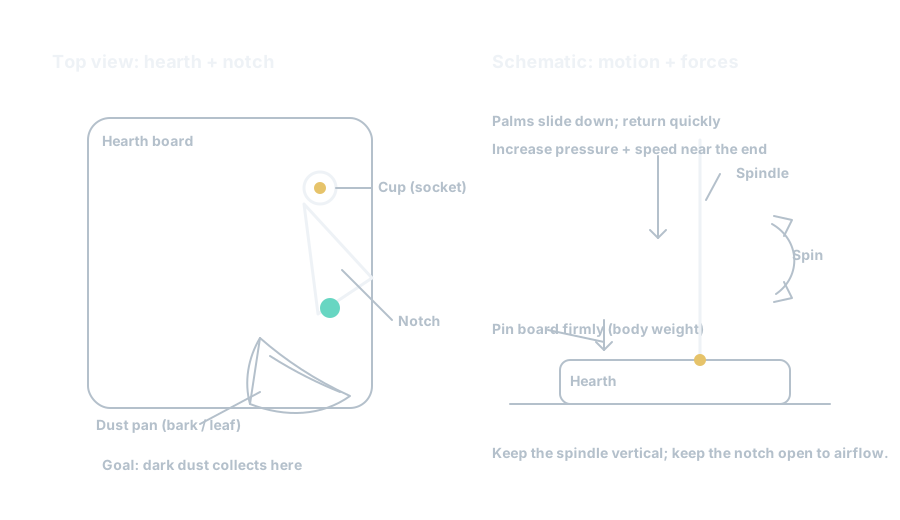
Steps
1) Prepare the hearth depression
- Place the hearth on the ground.
- Make a shallow round depression near the edge (not centered): about the width of the spindle.
- Smooth the depression so the spindle tip seats without slipping.
Level 0 method (no cutting tool): start the socket by pressing the spindle into the hearth and twisting hard to grind a shallow cup. If you have gritty sand, add a pinch as an abrasive. If you need to deepen/shape it, scrape with a naturally sharp stone edge (freshly broken rock often has a usable edge) or “peck” with a pointed pebble.
2) Cut a notch and make a “dust pan”
- From the edge of the hearth to the depression, create a notch shaped like a narrow pie-slice.
- Place a thin chip of bark/leaf/flat wood under the notch to catch the hot dust pile.
The notch gives the charred dust oxygen and lets it accumulate into a coal.
No cutting tool: scrape the notch using the sharpest stone edge you can find, working slowly from the edge toward the cup. Keep the notch narrow at the cup and widen it toward the outer edge.
3) Shape the spindle tips
- Bottom tip (on hearth): slightly blunt, like a rounded cone (not a sharp point). This makes more dust.
- Top tip (in hands): smoother and more pointed. This reduces friction on your hands.
4) Drill to produce dark, hot dust
- Place the spindle in the depression.
- Pin the hearth down with your foot close to the depression.
- Spin the spindle by rubbing your palms downwards; quickly return hands to the top and repeat.
- Start slow to “seat” the spindle, then increase speed and downward pressure.
Goal: a steady stream of dark brown/black dust that collects in the notch.
5) Form and mature the coal
- When the dust pile is large (about thumbnail-size), keep drilling for 10 to 20 seconds more.
- Stop gently and do not jostle the hearth.
- Wait 30 to 60 seconds. The dust pile should continue smoking and consolidate into a coal.
6) Transfer coal to tinder and make flame
- Move the dust pan with the coal into your tinder bundle.
- Fold tinder around the coal while leaving space for air.
- Blow steadily: start gently, then increase as the bundle glows.
- When it flares, move the burning tinder under your kindling structure and feed it.
Verification
- Dust: dark and warm-to-hot to the touch (careful).
- Coal: a single cohesive ember that keeps smoking when you stop drilling.
- Tinder bundle: glow spreads when you blow, then transitions to flame.
Safety
- Clear dry leaves from the area; prepare a bare-soil patch.
- Have water or dirt ready to extinguish.
- Do not attempt indoors or near flammable shelter materials.
Troubleshooting
Quick flow:
- Is the dust dark brown/black?
- If no: increase pressure/speed, ensure everything is truly dry, and try a different wood pairing.
- If yes: does the pile keep smoking for 30 to 60 seconds after you stop?
- If no: drill longer after the pile grows; reduce jostling; make sure the notch feeds air into the dust pile.
- If yes: does the coal survive transfer into the tinder bundle?
- If no: tinder is too damp/coarse, or you are crushing the coal; make tinder finer/drier and fold gently with airflow.
- If yes: does the bundle flare into flame when you blow?
- If no: blow steadily (not in gusts), protect from wind, and add a bit more fine tinder around the coal.
Common fixes:
- Spindle squeaks or “polishes” the hearth: roughen the contact surfaces and blunt the bottom tip slightly.
- Hands slip down too fast: shorten the spindle or use more consistent downward pressure; keep hands dry.