ArticlesMeasure Angles Without Tools (Degrees)

Measure Angles Without Tools (Degrees)
Tech Level 0
Last edited · 92a9d6f · tewelde
anglemeasuringlevel-0
Summary
An angle is a turn between two directions. Modern tools measure angles in degrees:
- A full turn is 360°
- A half turn is 180°
- A right angle is 90°
At low tech, you usually do not need “exact” degrees. What you do need is a way to reproduce a few reference angles reliably (90°, 60°, 45°, 30°) and describe other angles as “between” those references.
Prerequisites
- None (Level 0).
Diagram
Tools and materials (natural / Level 0)
- A straight stick (for a straightedge)
- A pointed stick or sharp stone edge (to scratch lines)
- Flat ground, sand, clay, or a flat board/stone surface you can mark
Optional but helpful:
- A flexible strip (bark strip, fiber strand) to use as a “compass” radius
Reference angles and how to make them
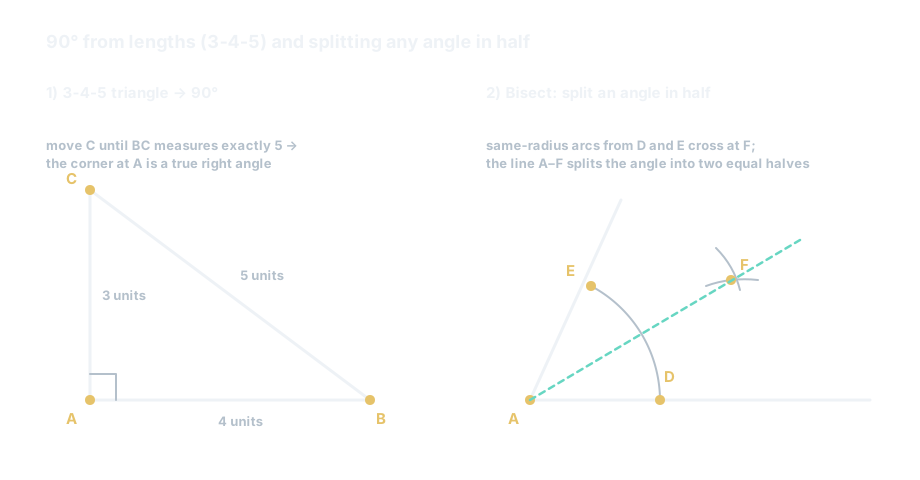
90° (right angle): 3-4-5 triangle
This makes a right angle using only lengths.
- Mark a point A on the ground.
- From A, mark a point B at 4 handspans (or any consistent unit).
- From A in a different direction, mark a point C at 3 handspans.
- Move point C until the distance BC is exactly 5 handspans.
- Draw lines AB and AC. The angle at A is 90°.
Any scaled version works (3-4-5, 6-8-10, 9-12-15). Use whatever size is easiest to measure.
60° (and 120°): equilateral triangle
- Draw a baseline AB (any length you choose).
- Using AB as the radius, draw an arc centered at A.
- Using AB as the radius, draw an arc centered at B so it crosses the first arc at C.
- Connect A-C and B-C. Triangle ABC has all sides equal, and angles of 60°.
If you cannot draw arcs cleanly, you can “step” the same stick length around: AB is the length, then mark C by finding a point that is one AB length from both A and B.
45°: bisect a 90° angle
- Make a 90° angle using the 3-4-5 method.
- Mark the angle corner point A and draw a short arc that crosses both legs of the angle at points D and E.
- From D, draw a small arc.
- From E, draw a small arc with the same radius so the arcs intersect at F.
- Draw line A-F. This line splits the right angle into 45° and 45°.
30° and 15°: bisect 60° (and then bisect again)
- Build a 60° angle using the equilateral triangle method.
- Use the same bisection steps above to split 60° into 30°.
- Bisect 30° to get 15°.
Using degrees in early articles (recommended style)
- Prefer descriptions like “shallow / moderate / steep” and “between 45° and 60°”.
- If you include degrees, add a reference like: “(about 60°; see Measure Angles Without Tools).”
Author vocabulary (use these words consistently across articles):
- Shallow = under 30° — e.g. a tuyere's downward tilt (10° to 20°).
- Moderate = 30° to 60° — e.g. an awl tip's cone.
- Steep = over 60° — e.g. a near-upright strike.
- Give ranges between references ("between 45° and 60°") rather than false-precision single numbers, and anchor at least one number to a reference angle from this article.
Verification
- 3-4-5 triangle: if your measured BC equals 5 units, the angle at A is a right angle.
- Equilateral triangle: if AB, BC, and CA match, all angles are 60°.
- Bisection: the bisector should look symmetric; if you mark equal distances along both legs, the bisector should land in the middle.
Safety
- Scratching lines with sharp stone edges can cut. Keep fingers behind edges and cut away from your body.
- Avoid marking angles on unstable ground where you can slip.
Troubleshooting
- My “right angle” looks off: your length units drifted. Re-measure and make the triangle larger (errors matter less when the triangle is big).
- Arcs don’t intersect cleanly: your radius changed. Use a fixed stick length and keep the pivot point stable.
- Lines are messy: scratch lightly first, then deepen once you are confident.
Variants
- Make an angle template board: scratch a 90° corner and a 60° corner into a flat board or plank so you can reuse it later.