
Measure Without Tools (Body Units)
Last edited · 92a9d6f · tewelde
Summary
Before you have rulers, you can still build reproducibly by using your body as a consistent measuring system. Your “units” will differ from other people’s, but they will be repeatable for you if you stay consistent.
This article defines a small set of body-based units and a simple way to make a durable reference so you can repeat dimensions across projects.
Prerequisites
- None (Level 0).
Diagram
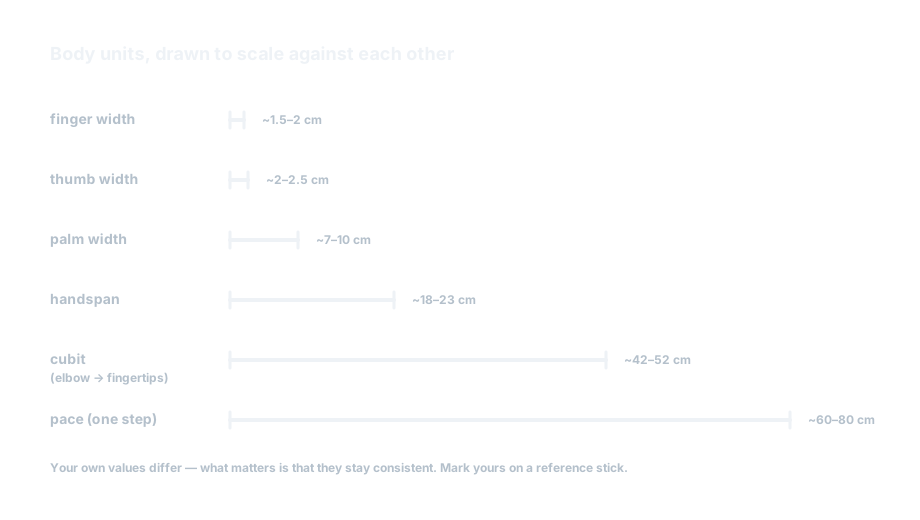
Units (choose a set and stick to it)
Pick a small set you will use everywhere:
- Finger width: width of your index finger (useful for small thicknesses).
- Thumb width: width of your thumb (useful for “thumb-thick” sticks).
- Palm width: width of your palm at the knuckles (good for small boards and bundles).
- Handspan: tip of thumb to tip of pinky with fingers spread.
- Cubit: elbow to fingertips (good for stick lengths and spacing).
- Pace: one normal step (good for distances and layouts).
Rule: avoid mixing units casually. If you write “arm-length” in one place, use “arm-length” again, not centimeters.
Rough modern equivalents, to sanity-check yourself (adult ranges; your own values will differ but stay consistent):
| Unit | Typical range |
|---|---|
| Finger width | 1.5 to 2 cm |
| Thumb width | 2 to 2.5 cm |
| Palm width | 7 to 10 cm |
| Handspan | 18 to 23 cm |
| Cubit (elbow to fingertips) | 42 to 52 cm |
| Pace (one step) | 60 to 80 cm |
Steps
1) Make a reference stick (optional but recommended)
This is a simple way to repeat measurements across days and across tasks.
- Find a straight, dry stick roughly forearm-length.
- Choose one end as the “zero” end.
- Mark handspans and palm-widths by notching or scratching the stick.
- Mark smaller units (finger widths) near one end for convenience.
If you have no cutting tool, you can scratch marks with a sharp stone edge, a hard pointed pebble, or by rubbing gritty sand into the wood with pressure.
2) Use “counted units” in your notes
When you write instructions, write them like:
- “Spindle: 4 handspans long, thumb-thick.”
- “Notch opening: 2 finger widths wide at the outer edge.”
If you want to help modern readers too, you can add metric in parentheses, but keep the primary instruction body-based.
Verification
- Measure the same object three times on different days: you should get the same count of units each time.
- Two people using the same reference stick should get the same result.
Safety
- If you scratch/notch sticks with sharp stone edges, treat them as knives: cut away from your body and keep fingers behind the edge.
Troubleshooting
- My measurements drift: you are changing where you place your fingers/hand. Always start from the same “zero” end and use the same posture.
- Reference marks wear off: deepen the scratches, choose harder wood, or make multiple reference sticks.
Variants
- Cord reference: once you can make cordage (Make Cordage (Plant Fibers)), tie knots every palm-width (Tie Basic Knots) and use the cord as a flexible measuring tape.