
Find and Prepare Clay
Last edited · 92a9d6f · tewelde
Summary
Clay is the foundation material of furnaces, pottery, and eventually bricks and metal-melting vessels. It is a special kind of fine-grained earth: wet it and it becomes plastic (it holds any shape you press it into), dry it and it goes hard, fire it and it becomes permanently stone-like.
This article covers finding clay in the landscape, testing whether a soil is actually clay, and cleaning and kneading it into a usable working body.
Terms used in this article
- Clay — earth fine and sticky enough to hold a molded shape; ordinary soil crumbles, clay does not.
- Plasticity — how well wet clay bends and holds shape without cracking or slumping.
- Clay body — the prepared, kneaded mix (clay plus any temper) that you actually build with.
- Temper — coarse material (sand, crushed fired clay, chopped dry fiber) kneaded into clay so it shrinks less and cracks less while drying and firing.
- Slaking — soaking dry or lumpy clay in water until it falls apart into mud.
- Leather-hard — partly dried clay: stiff like thick leather, but still carvable.
- Bone dry — fully dried clay: uniformly light in color, no longer cool against your cheek. Only bone-dry clay is safe to fire.
Prerequisites
- None (Level 0). A digging stick and water help; both are natural materials.
Diagram
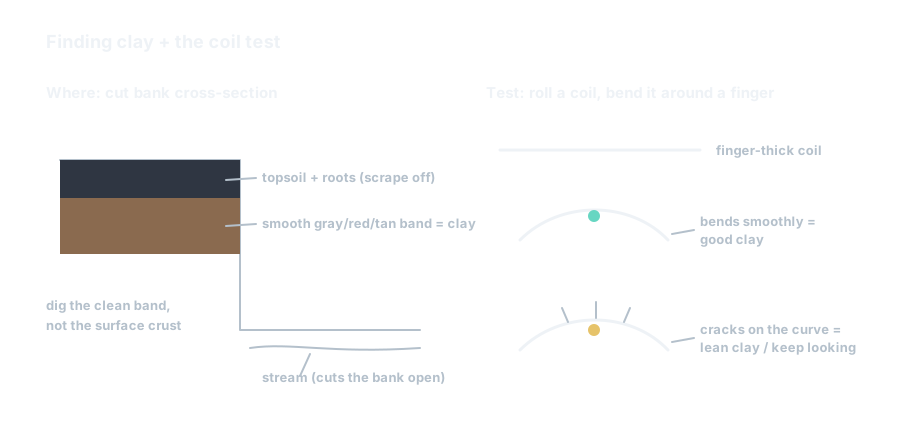
Where to search
Clay collects where slow water once dropped fine mud, and it hides under the dark living topsoil:
- Stream and river banks: look at freshly cut banks for smooth gray, red, tan, or blue-gray bands.
- Pond and lake margins, old flood plains, and drying puddle beds that crack into curling plates.
- Under the topsoil: dig a knee-deep test hole; many soils turn clay-rich below the root zone.
- Anywhere the ground turns slick and sticky when wet and your feet slide rather than sink.
Steps
1) Field-test a sample (the coil test)
- Take a lump the size of an egg, pick out stones, and work in a little water until it is putty-like.
- Roll it between your palms into a coil as thick as a finger and about a handspan long.
- Bend the coil around your finger.
Read the result:
- Bends smoothly around your finger with no cracks → good clay, use as-is.
- Bends but cracks on the outside of the curve → lean clay (low plasticity); usable for furnace walls, marginal for pots.
- Falls apart or will not roll into a coil at all → too sandy/silty; keep searching.
A second quick check: rub a wet pinch between thumb and finger. Clay feels slick and soapy; grit means sand or silt.
2) Dig and collect
- Scrape off topsoil and roots; collect from the clean band underneath.
- Prefer moist clay from depth over dry surface crust (less cleaning later).
- Collect more than you think you need; cleaning and drying lose volume.
3) Clean the clay
If it is fairly clean already (few stones, no roots): pick out debris by hand as you knead. Done.
If it is dirty or crumbly, clean it with water:
- Drop the clay into a water-filled pit, large shell, or bark-lined hollow and let it slake into mud.
- Stir into a thin slurry, then let it stand briefly: sand and pebbles sink first.
- Pour or scoop the still-cloudy water (the clay stays suspended longest) into a second hollow, leaving the settled sand behind.
- Let the second hollow stand until the clay settles and the clear water can be poured off.
- Let the clay paste dry until putty-stiff. Sunlight and wind speed this up; spreading it on a flat rock speeds it more.
4) Knead and add temper
- Knead the stiff clay like dough: press, fold, turn, repeat, squeezing out air pockets and evening out wet and dry spots. Air pockets burst when fired, so knead well.
- For furnace walls or anything that will be fired, knead in temper: about 1 part coarse sand to 2 to 3 parts clay, and/or small handfuls of chopped dry grass. The mix should still hold a coil but feel slightly gritty.
5) Shrinkage test (before big builds)
Clay shrinks as it dries; too much shrinkage means cracks. Test the finished body before committing it to a furnace or large pot:
- Roll a bar of the prepared body, about a handspan long and thumb-thick.
- Scratch two marks exactly a handspan apart (use your reference stick: Measure Without Tools (Body Units)).
- Dry the bar fully in shade (2 to 4 days), then measure the marks again.
- Read the result: marks closer by up to about one finger-width per handspan (roughly a tenth) and a straight, uncracked bar — good body. Shrinks more, warps, or cracks — knead in more sand temper and test again.
6) Store
Keep prepared clay wrapped in large leaves or bark, in shade. If it stiffens, knead water back in; if it slumps, dry it some more. Dried-out clay is not ruined — slake it and start again.
Verification
- A finger-thick coil bends around your finger without major cracking.
- A fist-sized test ball dried slowly in shade for a few days shows at most fine surface cracks (deep cracks: add temper or dry slower).
- A marked test bar shrinks no more than about a tenth of its length and dries straight (step 5).
- Tear a kneaded lump in half: the inside should be uniform, with no visible air pockets.
Safety
- Undercutting a stream bank can collapse it onto you; dig from the top or face, never tunnel under.
- Do not eat clay or prepare it in drinking-water sources.
- Avoid breathing the dust of bone-dry clay when crushing it; crush it damp or stand upwind.
Troubleshooting
- Everything I find cracks when coiled: blend two sources (a sticky one and a lean one), or use the cleaned, settled fraction from washing — it is the most plastic part.
- Clay is full of roots and crumbs: use the water-cleaning method; hand-picking is hopeless for fine debris.
- Dried test ball cracked deeply: too rich (too plastic) — add sand temper; or it dried in sun/wind — dry the next one slowly in shade.
Variants
- Stiff-mud shortcut: for rough furnace patching, clay straight from the ground with grass kneaded in is often good enough; skip washing.
- Blended body: keep two stockpiles (fat/sticky and lean/sandy) and blend to suit the job — fatter for pots, leaner for thick furnace walls.