ArticlesMake a Stone Flake Cutting Edge

Make a Stone Flake Cutting Edge
Tech Level 0
Last edited · 92a9d6f · tewelde
stoneknappingcuttingtoollevel-0
Summary
Many rocks fracture into sharp edges. By striking one rock with another, you can detach sharp flakes that act like knives and scrapers. A good flake can cut plant fibers, scrape wood, and shape bone or hardwood.
This is one of the most important Level 0 capabilities because it enables controlled cutting without metal.
Prerequisites
- None (Level 0).
Diagram
Materials
- Core stone: a fist-sized rock that fractures with sharp edges when struck.
- Hammerstone: a tougher rounded rock you can hold comfortably.
- Optional: a flat “anvil” rock to strike against.
Good places to search
- Riverbeds and gravel bars (many hard stones in one place)
- Fresh rockfall / broken outcrops (newly fractured edges)
- Exposed hill slopes after erosion
What to look for (practical, not species)
Try a few. You want a rock that:
- Breaks with a glass-like or shell-like curve (smooth curved fracture surfaces), and
- Produces edges that feel sharp enough to catch your fingernail (be careful).
If it turns to sand/dust or crumbles, it will not make good cutting edges.
Steps
1) Choose a safe work area
- Work on bare ground or a flat rock surface.
- Keep other people and bare feet away from the strike zone.
- Expect sharp chips to fly.
2) Detach flakes
- Hold the core stone firmly.
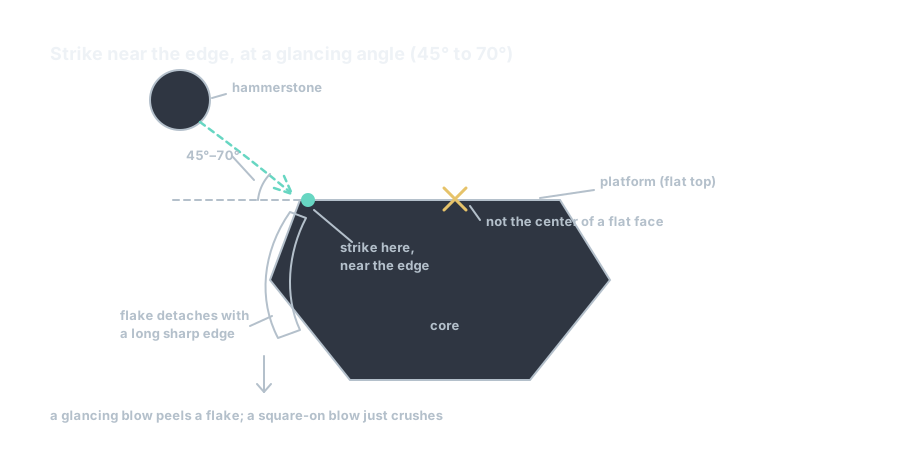
- Strike near an edge, not the center of a flat face.
- Aim for a glancing blow: roughly half to three-quarters of a right angle (about 45° to 70°; see Measure Angles Without Tools).
- After each strike, look for flakes with long sharp edges.
If the core is too large to hold, place it on an anvil rock and strike it from above.
3) Pick a usable flake and make it safe to hold
- Choose a flake with a long continuous sharp edge.
- Wrap the non-cutting side with bark, folded leaf, or cloth-like plant fiber to protect your palm.
- Keep the sharp edge pointed away from your fingers.
Do not “test sharpness” by sliding your finger along the edge. Tap the edge lightly against a dry twig or plant fiber instead.
Quick handles for more control:
- Bark wrap: fold a strip of thick bark over the blunt back of the flake and squeeze — enough for most cutting and scraping.
- Split-stick clamp: split a green stick a hand deep, seat the flake's blunt back in the split, and squeeze the stick closed in your fist for sawing strokes. Once you have cordage, bind the stick above and below the flake for a lasting knife (Make Cordage (Plant Fibers), Lash Objects Together (Cordage)).
Verification
A good cutting flake can:
- Shave thin curls from dry wood (scrape with controlled pressure).
- Slice plant fibers cleanly (tinder fibers, cordage fibers).
- Score a straight groove in soft wood.
Safety
- Stone flakes can be sharper than metal razors.
- Chips can fly into eyes. Keep your face back from the strike, and do not strike toward your body.
- Keep the work area clean; sharp flakes on the ground are foot injuries waiting to happen.
Storing and disposing of flakes
- Keep one bark slab as a "sharps tray" at the work spot; every flake and chip goes on it, never on the ground.
- Store keeper flakes folded in a bark or thick-leaf wallet, edges inward, tied or weighted shut, off the ground.
- Bury spent flakes and knapping chips in one marked spot away from paths, work areas, and sleeping ground — knapping debris stays razor sharp essentially forever.
- When done, sweep the area with a leafy branch and inspect at a low light angle: sharp chips glint.
Troubleshooting
- Core crumbles into gravel: choose a harder rock; try a different source (riverbed stones often work better).
- Flakes are short and thick: change strike angle; strike closer to an edge; rotate the core and try again.
- Nothing flakes off: your hammerstone may be too soft, or the core is too tough; try a heavier hammerstone or a different core.
Variants
- Scraper: pick a thick flake with a strong edge; scrape wood and animal hides (skins) with it.
- Sawing: a serrated edge can saw plant stalks and small branches by pulling repeatedly.