
Make Green-Wood Tongs
Last edited · 92a9d6f · tewelde
Summary
Fire work constantly needs you to grip things that would burn your hands: hot pots, glowing copper, coals, heated stones. The simplest reliable gripper is a pair of spring tongs bent from one piece of green wood. The fold acts as a spring that holds the arms open; squeezing them grips the work.
Green-wood tongs are quick to make and treated as disposable: the tips char with use and you simply make another pair.
Terms used in this article
- Green wood — freshly cut, sap-filled wood. It is flexible and bends where dry (seasoned) wood snaps, and it resists catching fire much longer.
- Spring tongs — tongs made from one bent piece, where the bend itself springs the arms apart.
Prerequisites
- A cutting/scraping edge: Make a Stone Flake Cutting Edge
Diagram
Materials
- One straight, freshly cut (green) branch: about an arm-length long and thumb-thick, with no knots near the middle
- A stone flake for shaving wood
- Optional: cordage for a stop-band near the bend
Steps
1) Cut and choose the stick
- Cut a live, springy branch — willow, hazel, and similar shoot wood are ideal, but any branch that bends without cracking works.
- Strip off twigs and leaves.
- Flex it gently: it should bow easily and snap back.
Springiness test for an unfamiliar tree: bend a pencil-thick twig from it into a U. If it springs back with no cracking sound, the wood is right. If it folds with white crushed fibers on the outside of the bend, or snaps outright, look elsewhere.
2) Thin the middle (the hinge)
- Find the midpoint.
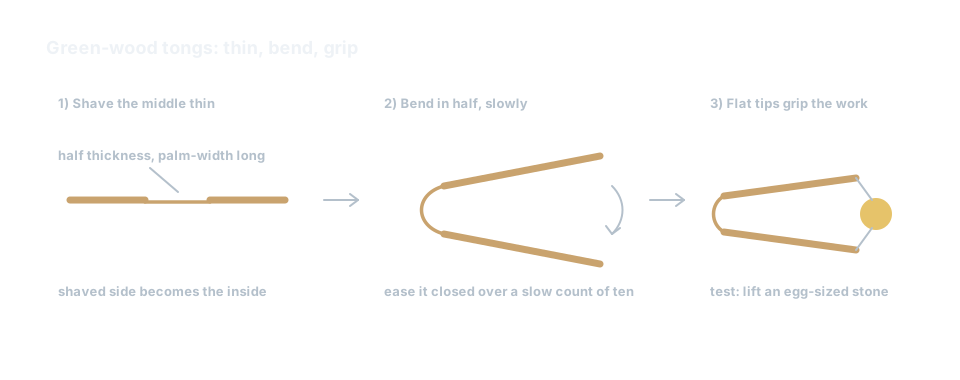
- With the stone flake, shave the middle section — about a palm-width long — down to half its thickness. Shave from one side only; the shaved side will become the inside of the bend.
- Leave the rest of the stick full thickness for stiff arms.
3) Bend
- Warm the thinned section near a fire for a minute if you have one (heat makes the bend safer; it is optional with good green wood).
- Bend the stick slowly in half over your knee, shaved side inward, easing it closed over a slow count of ten rather than folding it in one motion.
- Some surface fibers on the outside of the bend may tear — fine. A full snap means the hinge was too thick or the wood too dry; thin it more or cut a fresh stick.
4) Fit the tips
- Bring the two arm ends together; trim them to equal length.
- Flatten the inside faces of the last finger-length of each tip so they meet flat against each other — flat faces grip; round ones roll the work out.
- Optional: cut shallow cross-notches into the gripping faces for bite.
5) Optional stop-band
Tie a snug band of cordage around both arms a palm-width below the bend — a few tight wraps finished with two half-hitches (Tie Basic Knots). It stops the bend from opening flat and makes the spring stiffer.
Verification
- The tongs pick up an egg-sized stone and hold it through a firm shake.
- Arms spring back open when you release.
- You can lift a small hot pot or a coal smoothly without a second hand.
Safety
- Green wood resists burning but is not fireproof: take the work out of the fire with the tongs, do not leave the tongs lying in it.
- Dip the tips in water before gripping glowing material; expect steam.
- Charred, weakened tips drop the load without warning — retrim or replace them as soon as they blacken deeply.
Troubleshooting
- Stick snapped at the bend: hinge too thick, bent too fast, or wood too dry. Thin to half thickness, bend slowly, use freshly cut wood.
- Tongs will not hold anything heavy: arms too thin or springy — use a thicker branch; or tips do not meet flat — re-flatten the faces.
- Bend keeps creeping open: add the cordage stop-band, or hang the tongs closed around a thick stick overnight so the hinge takes a set.
Variants
- Two-stick chopstick grip: in a pinch, two stiff sticks used one-in-each-hand move coals fine; tongs just free your other hand.
- Carved collar (no cordage): instead of the cordage stop-band, cut a short stick with a shallow notch near each end, squeeze the arms slightly together, and seat the collar across both arms a palm-width below the bend — the arms' own spring locks it in place. Knock the collar off to let the tongs open wide.
- Forked-tip tongs: leave a small natural fork at each tip to cradle round objects like pots and stones.