
Tie Basic Knots
Last edited · 92a9d6f · tewelde
Summary
A knot lets a cord grip itself, another cord, or an object. Almost every early tool that uses cordage — fishing lines, bindings, handles, shelters — depends on a few simple knots. This article teaches five knots that cover most needs, plus the words used to describe rope work so other articles make sense.
Terms used in this article
- Working end — the free end of the cord that you move around while tying.
- Standing part — the rest of the cord: the long portion that stays still (and usually carries the load).
- Loop — a circle of cord made by crossing the cord over itself.
- Bight — a U-shaped bend in the cord that does not cross itself.
- Hitch — a knot that ties a cord to an object (a pole, a stone, another cord's standing part).
Prerequisites
- Cordage to practice with: Make Cordage (Plant Fibers)
Diagram
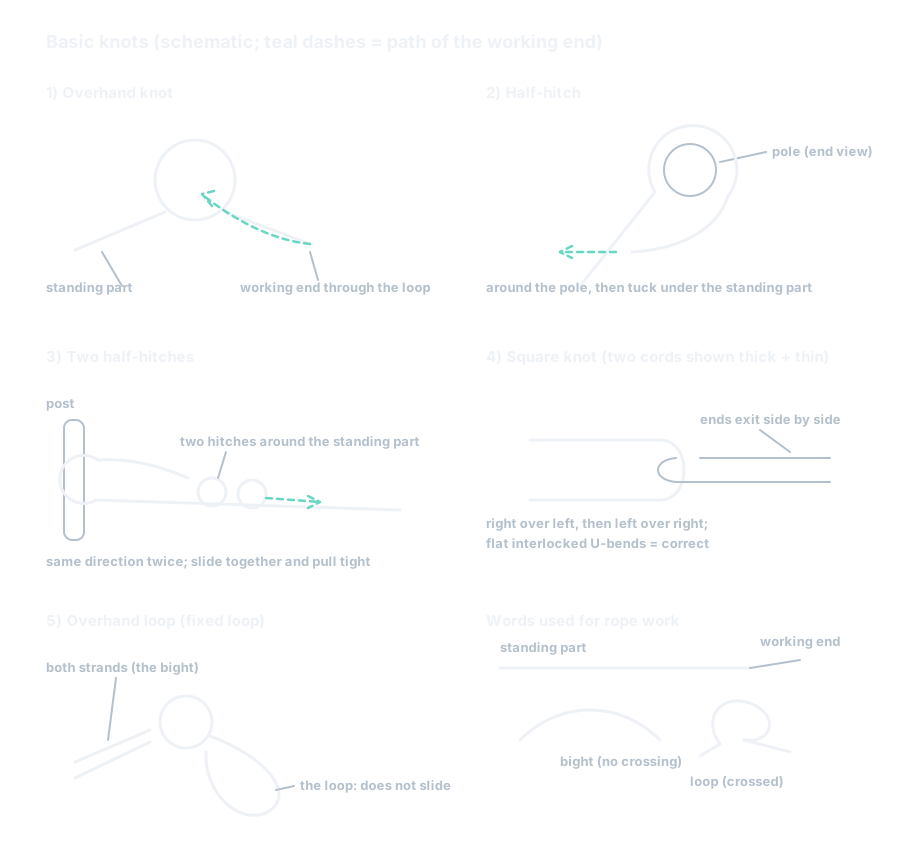
Materials
- An arm-length piece of cordage (plus a second piece for the square knot)
- Any stick or pole to practice hitches on
Steps
1) Overhand knot (a stopper)
Use it to keep a cord end from fraying or untwisting, or to make a thick spot that cannot slip through a hole.
- Make a loop near the working end: cross the working end over the standing part.
- Pass the working end through the loop from behind.
- Pull the working end and standing part in opposite directions until the knot is firm.
2) Half-hitch (the building block)
A single half-hitch grips an object weakly by itself, but it is the building block for stronger hitches.
- Pass the working end around the object (pole, stone, or another cord).
- Bring the working end across the standing part.
- Tuck the working end under the standing part and back up through the gap it just made.
- Pull snug.
3) Two half-hitches (a lock that holds under load)
This is the standard way to finish a tie so it does not slip — used, for example, to lock the lashing on a fishing gorge.
- Tie one half-hitch around the standing part (step 2 above).
- Tie a second half-hitch right next to the first, in the same direction.
- Slide the pair together and pull hard on the standing part to set them.
Tied in the same direction, the two hitches jam against each other and tighten under load instead of loosening.
4) Square knot (joins two cord ends)
Use it to tie two ends of similar thickness together — closing a bundle, joining two short cords for light duty.
- Hold one end in each hand.
- Cross right over left, and wrap once (like the first move of tying shoelaces).
- Cross left over right, and wrap once.
- Pull both pairs of ends. The knot should look like two interlocked U-bends lying flat.
If it instead looks twisted and slips when pulled, you crossed the same way twice (a "granny knot"); untie and redo.
5) Overhand loop (a fixed loop)
Use it to put a permanent loop in a cord: hanging tools, anchoring a line over a stub, or making a toggle attachment (loop over a short stick).
- Fold a bight near the end of the cord.
- Tie an overhand knot (step 1) using the doubled cord — the bight acts as the working end.
- Pull the loop and both strands tight.
The loop does not slide. It jams hard after heavy load; plan to cut it rather than pick it open.
Choosing a knot
| Knot | Best for | Avoid for |
|---|---|---|
| Overhand | stopping a cord end from fraying or slipping through a hole | joining cords (it jams and weakens them) |
| Half-hitch | a quick temporary hold; the building block of other hitches | anything load-bearing on its own |
| Two half-hitches | tying a line to poles, stakes, or its own standing part under steady load | very slick, stiff cord unless snugged hard |
| Square knot | joining two ends of similar cord; closing bundles and wraps | cords of different thickness; anything life-critical |
| Overhand loop | a fixed loop for toggles, hanging, anchoring | loops you will need to untie after heavy load |
Verification
- Each knot holds when you pull hard in the direction of normal load.
- The overhand knot does not slide off the end.
- Two half-hitches tighten (not loosen) when the standing part is loaded.
- The square knot lies flat and symmetric; a hard pull does not make it slip or capsize.
- The overhand loop keeps its size under load and does not slide along the cord.
Safety
- Do not wrap cordage around fingers when load-testing; pull with hands gripping the cord.
- A knot weakens a cord at the knot. Expect a knotted cord to break before an unknotted one; size your cordage with margin.
Troubleshooting
- Knot slips: cord too stiff or slick — dampen plant-fiber cordage slightly; add a second half-hitch; leave a longer working end.
- Knot jams and cannot be untied: normal for plant-fiber knots under heavy load; cut the cord rather than weakening it by picking.
- Square knot capsizes into a slipping tangle: do not use it to join cords of very different thickness, and never where life or major work depends on it; use more wraps and hitches instead.
Variants
- Slipped knots: finish any knot by tucking a bight (instead of the full end) through the last pass — pull the free end and the knot unties instantly. Useful for ties you will undo often.
- Timber hitch: wrap the working end around the standing part three or more times after circling a log — quick to tie and untie for dragging loads.