ArticlesLash Objects Together (Cordage)

Lash Objects Together (Cordage)
Tech Level 2
Last edited · 92a9d6f · tewelde
lashingcordageknothaftingfiber
Summary
Lashing is binding with many tight wraps of cordage. Where a knot grips at a single point, a lashing clamps along a whole band: each wrap presses the parts together and friction does the holding. Lashing attaches lines to hooks, heads to handles, sticks to sticks, and sinkers to lines — it is the standard way to join parts before glue, nails, or screws exist.
Terms used in this article
- Wrap (turn) — one full pass of the cord around the objects being bound.
- Frapping turns — wraps taken around the lashing itself, between the two objects, to cinch the band tighter.
- Standing part / working end / half-hitch — see Tie Basic Knots.
Prerequisites
- Cordage: Make Cordage (Plant Fibers)
- Knots for starting and locking the lashing: Tie Basic Knots
Diagram
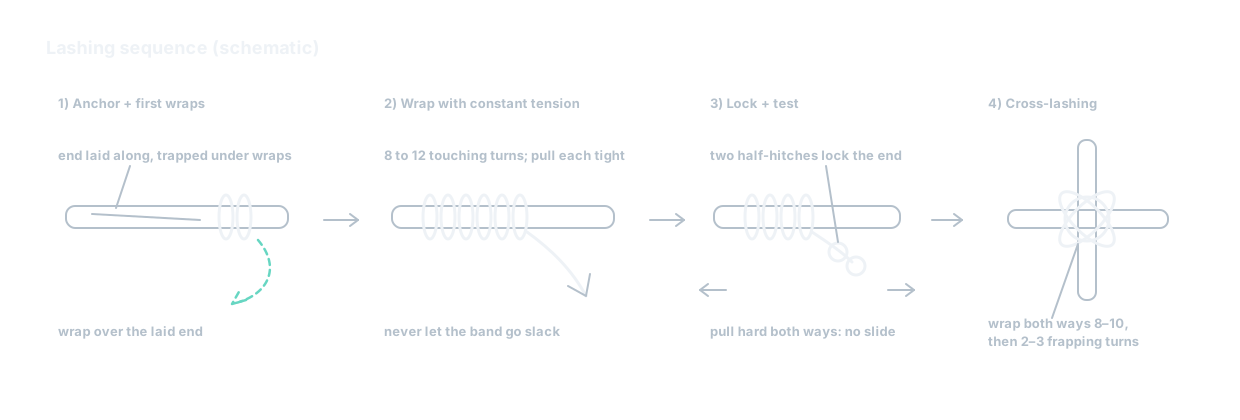
Materials
- Cordage: about an arm-length per lashing (more for thick objects)
- The objects to bind (e.g. a line to a gorge hook, a stone to a line, a blade to a handle)
Steps
1) Prepare the surfaces
- Smooth sharp corners that could cut the cord.
- If you can, scrape a shallow notch or groove where the cord will sit, so the wraps cannot slide.
- Slightly damp plant-fiber cordage grips better and shrinks tight as it dries.
2) Anchor the first wrap
- Lay the working end along the object, pointing away from where you will wrap.
- Make the first wrap over the laid end, trapping it underneath.
- Make a second wrap over it, pulling hard. The trapped end now anchors itself.
(Alternative anchor: start with a half-hitch around the object.)
3) Wrap with constant tension
- Wrap side by side — each new turn touching the previous one, not crossing it.
- Pull every wrap as tight as you can without breaking the cord, and do not let tension off between wraps: hold the band with a thumb while repositioning your hands.
- Use 8 to 12 wraps for small bindings (a fishing gorge, a sinker); more for handles and joints that take leverage.
If two crossing sticks are being lashed, wrap around the cross both ways, then add 2 to 3 frapping turns between the sticks and pull them brutally tight — frapping is what makes a cross-lashing rigid.
4) Lock the lashing
- Finish with two locking half-hitches around the standing part or around the bound object (see Tie Basic Knots).
- Alternative: tuck the working end back under the last two or three wraps and pull it through hard.
- Trim or melt-seal nothing — just leave a thumb-width tail so the lock cannot work free.
5) Test
- Pull and twist the bound parts against each other hard, harder than expected use.
- The wraps must not slide along the object or open gaps between turns.
Wrap counts by job
| Job | Wraps | Notes |
|---|---|---|
| Line to a gorge hook | 8–12 | finish with two half-hitches on the standing part |
| Stone sinker to a line | 6–10 | seat the wraps in a scraped groove so they cannot slide |
| Tool head to handle (hafting) | 15–25 | add 2–3 frapping turns; retighten after the first real use |
| Stick-to-stick cross | 8–10 each direction | then 2–3 frapping turns between the sticks, pulled brutally tight |
Verification
- The band of wraps is even, touching, and does not shift under a hard pull.
- The locked end does not creep loose when the lashing is loaded and released repeatedly.
- For tool handles: strike a few light test blows; the head must not rotate or walk.
Safety
- Cordage pulled tight can cut skin: pull with your hand wrapped in bark or cloth, never with cord looped around fingers.
- A lashing that fails under load releases parts suddenly; always test at low stakes first.
Troubleshooting
- Wraps slide along the object: add or deepen notches; wrap over a slight bulge or taper from the thick side toward the thin side.
- Lashing loosens after drying: cord was wet and shrank unevenly, or tension was lost between wraps; re-lash slightly damp and keep constant tension.
- Cord breaks while tightening: cordage too thin or weak for the job; use thicker cordage rather than more gentle wraps.
Variants
- Whipping: the same technique wrapped around a cord's own end stops fraying.
- Serving: long continuous wrapping along a section of cord or handle protects it from wear and improves grip.