
Make a Copper Awl (Metal Tool)
Last edited · ccbfd9f · tewelde
Summary
This is a first practical metal tool: a copper awl. You consolidate copper prills into a small billet, then forge and anneal it into a tapered point. The awl can pierce leather, bark, and thin wood, and it becomes a gateway tool for more precise fabrication.
Terms used in this article
- Prill — a small droplet/bead of metal recovered from smelting (see Smelt Copper Prills (Small Batch)).
- Billet — a small consolidated block of metal, ready to be shaped into a tool.
- Forge / forging — shaping metal with hammer blows, usually while it is hot.
- Work-hardening — copper stiffens and eventually cracks as you hammer it; explained in Anneal Copper (Soften Work-Hardened Metal).
- Anneal — heat the copper to a dull red glow and cool it to make it soft again; full method in Anneal Copper (Soften Work-Hardened Metal).
- Hafting — fitting a tool head onto a handle.
- Hammerstone / anvil stone — natural rocks used as hammer and work surface; how to choose them is covered in Make a Stone Flake Cutting Edge.
Prerequisites
- Copper source: Smelt Copper Prills (Small Batch)
- Softening between hammering sessions: Anneal Copper (Soften Work-Hardened Metal)
- Forging heat: Make Charcoal Fuel (Pit Method)
- Fire source: Make Fire (Hand Drill)
- Optional binding/hafting: Make Cordage (Plant Fibers) and Lash Objects Together (Cordage)
Diagram
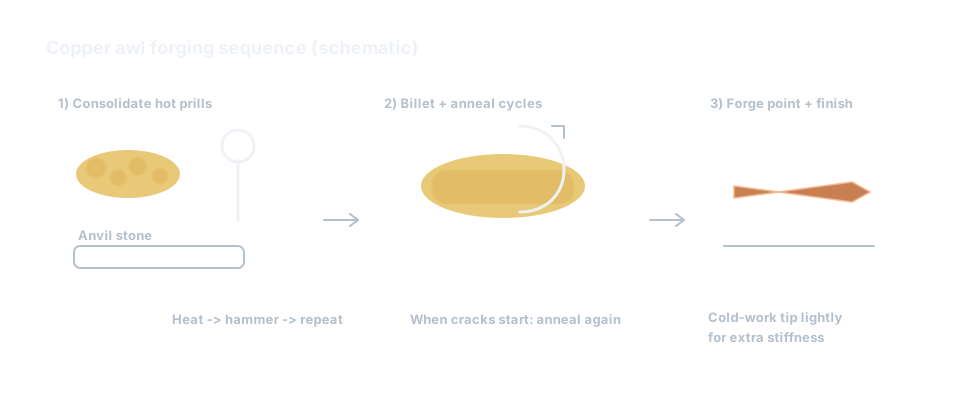
Materials
- Copper prills, enough to make a finger-length tool blank: Smelt Copper Prills (Small Batch)
- Charcoal fire: Make Charcoal Fuel (Pit Method), lit with Make Fire (Hand Drill)
- Flat anvil stone — a hard natural rock with a flat face (choosing suitable stone: Make a Stone Flake Cutting Edge)
- Hammerstone — a tough rounded rock (choosing suitable stone: Make a Stone Flake Cutting Edge)
- Optional wooden handle (a split stick) and cordage to lash it on
Steps
1) Consolidate prills into a billet
- Heat a pile of copper prills in a concentrated charcoal zone.
- When hot, move them onto a flat anvil stone.
- Hammer firmly to weld/compact into a single lump.
- Repeat heat-and-hammer cycles until you have one cohesive billet.
If the billet starts cracking while hammering, anneal again (next step).
2) Anneal often
- Heat copper until dull red in low light.
- Remove and let cool (air cool is fine).
- Resume hammering.
Copper work-hardens quickly; frequent annealing prevents cracking. If you have not annealed before, read Anneal Copper (Soften Work-Hardened Metal) first — it explains the signs that it is time to anneal and how to judge "dull red".
3) Forge the point
- Hammer one end into a tapered cone.
- Rotate while hammering to keep the point centered.
- Keep the opposite end thicker for grip or hafting.
Target shape:
- Tip: sharp but not needle-fragile
- Body: straight and gradually tapering
Target geometry by use (angles: Measure Angles Without Tools (Degrees)):
| Tool | Overall length | Tip | Shaft |
|---|---|---|---|
| Awl (general piercing) | about a finger-length | sturdy cone, moderate point (about 30°–45°) | half a finger-width, tapering smoothly |
| Scribe (marking wood/clay) | a finger-length or a bit more | fine point (about 20°–30°) | slimmer than an awl; expect to resharpen often |
| Punch (heavy piercing) | half to two-thirds of a finger-length | stout point (about 60°–90°) | thickest of the three; short means stiff |
4) Straighten and finish
- Lightly hammer along the shaft on a flat stone to straighten.
- Work-harden only the tip with gentle cold hammering for extra stiffness.
- Polish/smooth by rubbing with fine stone or sand.
5) Optional handle
- Split a small stick.
- Seat the thick end of awl in the split.
- Lash tightly with cordage (technique: Lash Objects Together (Cordage)).
Maintenance and repair
Copper is soft; treat sharpening and straightening as routine care, not failure.
- Dull tip: rub on a fine-grained wet stone while rotating the shaft, then set the edge with a few light cold taps.
- Bent shaft (usually from prying — avoid prying): anneal, straighten with light blows on a flat stone, re-harden only the tip with gentle cold hammering.
- Cracked or crumbled tip: grind or cut back past the damage, anneal, and reforge the taper. The tool gets shorter each time; that is normal.
What to expect over a tool's life: the tip dulls after sessions of heavy piercing and needs regular touch-up; the most common failure is a bent tip from side-loading, the second is a mushroomed butt if you hammer on the awl (use a punch for struck work). A finger-length awl typically survives many re-sharpenings before it is too short and gets reforged into a punch.
Verification
- Awl tip can pierce leather/bark with controlled hand pressure.
- Tool remains straight after repeated use.
- Tip does not chip or crumble under normal piercing loads.
Safety
- Hot copper looks similar to cold copper in bright light; treat all recently heated metal as hot.
- Hammer strikes can eject metal fragments; keep bystanders clear.
- Do not hold tiny hot pieces with bare fingers.
Troubleshooting
- Billet won’t consolidate: prills may be oxidized/dirty; reheat hotter and hammer sooner after heating.
- Cracks appear while forging: anneal more frequently.
- Tip bends too easily: cold-work the final tip more, or make tip slightly thicker.
- Tip breaks: over-worked or too sharp; re-anneal and reforge with a sturdier taper.
Variants
- Scribe: longer, finer tip for marking wood/clay.
- Punch: shorter, stouter tip for heavier piercing.
- Mini chisel: flatten tip instead of sharpening to a point.