
Make a Gorge Hook + Handline (Fishing Tool)
Last edited · 92a9d6f · tewelde
Summary
A gorge hook is one of the simplest early fishing hooks: it is a small straight piece of bone or hard wood tied at the middle. Bait covers the gorge. When a fish swallows it and you pull the line, the gorge turns sideways and catches.
This article covers making a gorge hook, attaching it to a handline, and basic ways to fish with it.
Terms used in this article
- Eddy — a calm pocket of slowly circling water just downstream of a rock or bank; fish rest there out of the current.
- Standing part / half-hitch — rope-work words, explained in Tie Basic Knots.
Prerequisites
- Cordage for line: Make Cordage (Plant Fibers)
- A sharp cutting edge for shaping: Make a Stone Flake Cutting Edge
- Knots for locking the tie: Tie Basic Knots
- Wrapping technique: Lash Objects Together (Cordage)
Diagram
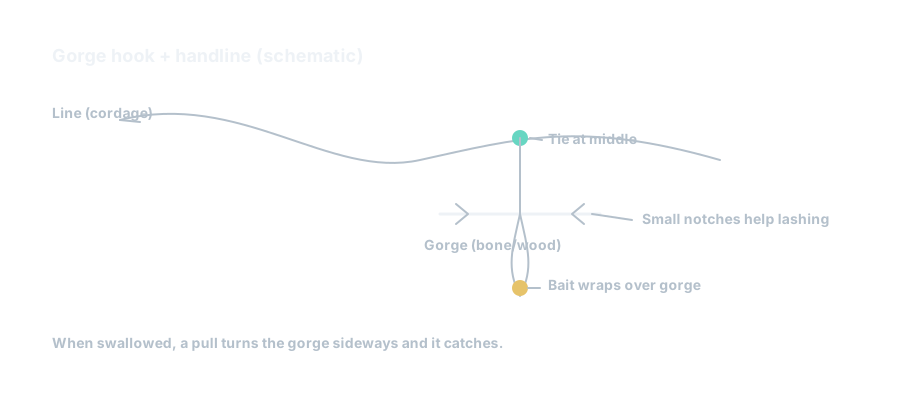
Materials
- Cordage line: several arm-lengths (longer line is easier in deeper water)
- Gorge material (choose one):
- Bone (dense, not crumbly), or
- Hard wood (dense, fine-grained), or
- A strong thorn (small fish)
- Bait (worms, insects, small meat, fish scraps)
- Optional: small stone sinker, simple float (bark/wood)
Steps
1) Make the gorge
- Cut a straight piece about finger-length.
- Smooth sharp corners so it does not cut your lashing.
- Cut a small notch near each end (not deep; just enough to keep the lashing from slipping).
If using wood: choose a straight-grained piece and avoid punky or cracked wood.
Sizing by target fish (when in doubt, go smaller — a small gorge catches big fish more often than the reverse):
| Target fish | Gorge length | Gorge thickness | Line |
|---|---|---|---|
| Palm-sized | about 2 finger-widths | grass-stem thin | thinnest even 2-ply |
| Hand- to forearm-length | half to one finger-length | twig thin | standard 2-ply |
| Larger | a full finger-length or slightly more | up to half a thumb-width | doubled line or 3-ply |
2) Tie the line to the middle
Goal: the line must not slip off-center.
- Lay the line across the middle of the gorge.
- Wrap tightly around the gorge 8 to 12 turns, keeping constant tension (full technique: Lash Objects Together (Cordage)).
- Finish with two locking half-hitches around the standing part of the line (how to tie them: Tie Basic Knots), or tie off by tucking the end under the last wraps and pulling tight.
- Pull hard to test: the lashing should not slide.
3) Add optional sinker and float
Sinker (stone):
- Pick a small smooth stone.
- Lash it 1 to 2 handspans above the gorge (wrap + jam the line into a shallow groove if you can scrape one).
Float (bark/wood):
- Lash a small buoyant piece of bark/wood to the line above the sinker.
You can fish without either: a sinker helps get bait down; a float helps detect bites.
4) Bait the gorge
- Wrap bait so it covers the gorge and hides the line tie.
- Do not leave the gorge exposed; the goal is for the fish to swallow it.
Keeping bait on:
- Bind soft bait with a few turns of the thinnest fiber you have (a single ply teased from cordage scrap works).
- In current, prefer tough baits — grubs, snails, meat scraps with skin on — over soft ones that wash off.
- Re-bait after every strike: half-stripped bait exposes the gorge, and fish refuse an exposed gorge.
5) Fish with the handline
Pick a low-risk spot (avoid fast current and deep water).
- Lower or cast the baited gorge into water.
- Keep light tension and watch for repeated tugs or a steady pull.
- When you feel a solid pull, lift firmly and keep tension (do not jerk wildly).
- Guide the fish to shore or shallow water.
Method options:
- Still water: fish near cover (rocks, submerged branches, edges).
- Moving water: fish behind rocks and in slower eddies.
- Set line (higher risk of loss): tie the free end to a branch and check often.
Verification
- Lashing holds a hard pull without slipping.
- Gorge survives wetting and pulling without snapping.
- Bait stays on during gentle test dips.
Safety
- Water is dangerous: avoid slippery rocks, do not wade into strong currents, and do not fish alone if you can avoid it.
- Hooks are sharp: keep away from eyes and do not wrap line tightly around fingers.
- Food safety: raw fish can carry parasites and pathogens. If possible, cook fish thoroughly (see Make Fire (Hand Drill)).
Troubleshooting
- Fish take bait but you catch nothing: the gorge may be too long/thick for the fish size; make a smaller gorge and use smaller bait.
- Lashing slips: deepen end notches slightly and add more wraps; use drier/tougher cordage.
- Line breaks: cordage is too weak or damaged; make thicker line or switch fiber source.
- Bait falls off: wrap bait with a thin fiber tie, or use stickier bait.
Variants
- Improvised hook: a bent thorn or carved wooden hook can work, but gorges are simpler at low tech.
- Carved barbless hook: carve a J-shape from a naturally forked twig joint or dense bone, sharpening the short arm into the point. No barb means the fish stays on only while the line is tight — keep steady tension from strike to shore. Harder to make than a gorge, but reusable, easier to unhook, and better when fish are striking but not swallowing.
- Simple spear: sharpened stick fishing works in shallow clear water.
- Trap/weir: in some locations, passive fish traps are more efficient than hook-and-line.