ArticlesBuild a Small Clay Furnace (With Tuyere)

Build a Small Clay Furnace (With Tuyere)
Tech Level 1
Last edited · 92a9d6f · tewelde
furnaceclayairflowheatsmeltingtemper
Summary
A small clay furnace concentrates heat and airflow so charcoal can reach temperatures suitable for early metallurgy. This version is a simple shaft furnace made from clay, sand, and fiber temper, with a clay air tube (tuyere).
Terms used in this article
- Tuyere — the clay tube that carries the air blast through the furnace wall into the charcoal bed.
- Temper — sand, grog, or fiber mixed into clay so it shrinks less and cracks less when drying and firing.
- Course — one horizontal layer of clay added all the way around the wall; the furnace is built up course by course.
- Bore — the open space inside the shaft, where the charcoal and charge sit.
- Leather-hard — clay dried just enough to be stiff and no longer soft, like thick leather; firm but not yet bone dry.
- Backflow — hot gases pushing backward out through the tuyere instead of air flowing in.
- Turbulence — air tumbling and swirling instead of flowing smoothly; rough inner walls cause it and it weakens the draft.
- Spall — when heated clay or stone pops and throws off hot sharp fragments, usually from trapped moisture.
Prerequisites
- Fire source: Make Fire (Hand Drill)
- Body-unit sizing: Measure Without Tools (Body Units)
- Angle references (for tuyere angle): Measure Angles Without Tools (Degrees)
- Clay sourcing and kneading: Find and Prepare Clay
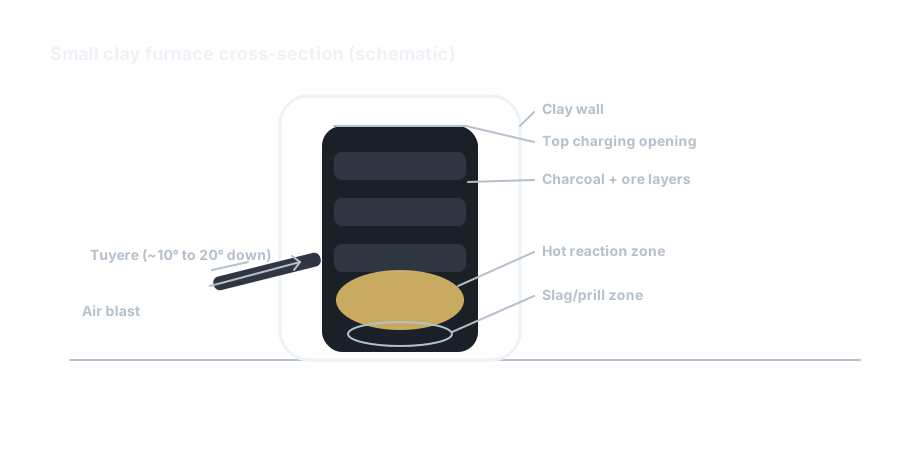
Diagram
Materials
- Clay-rich soil (how to find and test it: Find and Prepare Clay)
- Sand or grog (to reduce cracking); grog is crushed fired clay, e.g. broken pottery from Fire a Clay Pinch Pot (First Pottery)
- Chopped dry grass or straw (fiber temper)
- Water
- Flat stones for base
- Charcoal (for drying/firing cycles)
Steps
1) Mix furnace clay body
- Start with roughly 2 parts clay-rich soil and 1 part sand/grog.
- Add chopped dry fiber (small handfuls) until mix is tough and not sticky-sloppy.
- Add water gradually and knead until uniform.
Test a fist-sized ball:
- If it cracks badly while drying, add more sand/grog.
- If it crumbles, add more clay/water.
2) Build a stable base
- Choose bare ground sheltered from strong wind.
- Lay flat stones or compacted clay as a base.
- Form a short ring wall as the first course.
3) Build the shaft
- Build a cylindrical shaft about knee-high to mid-thigh-high.
- Keep the internal bore about 1 to 2 handspans wide.
- Wall thickness: about a thumb to two fingers.
Smooth inside walls to reduce turbulence and weak points.
4) Add tuyere port and tuyere tube
- Make an inlet hole near the lower side wall, just above base level.
- Angle it slightly downward into the furnace (about 10° to 20° downward from horizontal).
- Form a clay tuyere tube and seat it in this hole.
The downward angle helps focus heat near the reaction zone and reduces backflow.
5) Dry slowly
- Air-dry until leather-hard (surface no longer soft).
- Start a tiny warming fire inside to drive off moisture.
- Increase to several small drying fires over hours.
Do not full-fire while wet, or the furnace may steam-crack.
Typical drying times before pre-firing (thumb-thick walls; two-finger walls take longer):
- Hot, dry, breezy weather: 2 to 4 days to leather-hard, then 3 to 5 more days.
- Mild weather: about a week to leather-hard, 1 to 2 weeks total.
- Cool or humid weather: 2 to 4 weeks total; the small warming fires matter much more.
When in doubt, wait longer — steam cracks destroy more furnaces than patience does.
6) Pre-fire before production use
- Run a stronger charcoal fire for 1 to 2 hours.
- Observe and patch cracks with fresh clay mix as needed.
- Let cool; re-patch and dry if large cracks appear.
Verification
- Furnace stands without slumping.
- Tuyere remains fixed and open.
- Walls survive repeated heating without major collapse.
- Charcoal can maintain a bright, concentrated hot zone near tuyere level.
Safety
- Hot clay and stones can spall; keep face and eyes back from openings.
- Fumes and carbon monoxide are hazardous; operate outdoors with airflow.
- Keep water and soil nearby for fire control.
Troubleshooting
- Wall cracks everywhere: too much clay/not enough temper; remix and patch with more sand/grog.
- Tuyere clogs: angle or opening too small; enlarge and keep clean with a stick while hot.
- Weak heat: furnace too wide, not enough charcoal, or insufficient airflow.
Variants
- Pit furnace: below-grade bowl with side tuyere (simpler, usually lower output).
- Two-tuyere furnace: two tuyeres at the same height, about a third of the way around from each other (never directly facing, or the blasts fight), both angled 10° to 20° down. The hot zone grows and heats more evenly, but it needs two people blowing (or disciplined alternating) and burns charcoal faster. Build and master the single-tuyere version first; convert only if one side of your charge keeps coming out unreacted.