ArticlesFire a Clay Pinch Pot (First Pottery)

Fire a Clay Pinch Pot (First Pottery)
Tech Level 1
Last edited · 92a9d6f · tewelde
potterypinch-potclayfiringdryingtemper
Summary
A pinch pot is the simplest pottery: a cup squeezed out of one ball of clay with your thumbs and fingers, then fired. Firing changes clay permanently — a fired pot no longer softens in water. Even one small fired cup unlocks new capabilities: holding water near a fire, testing ore samples, charring materials in a sealed container, and (later) vessels for melting metal.
Terms used in this article
- Pinch pot — a vessel formed by pinching a ball of clay between thumb and fingers while rotating it.
- Bone dry — clay dried until uniformly light-colored and no longer cool against your cheek. Firing clay that is not bone dry makes it burst.
- Open firing — hardening pottery in or under an ordinary wood fire; no built oven is needed.
- Spall — when heated clay or stone pops and throws off hot fragments, usually from trapped moisture.
- Temper — coarse material in the clay body that helps it survive drying and firing (see Find and Prepare Clay).
Prerequisites
- Prepared, tempered clay: Find and Prepare Clay
- Fire: Make Fire (Hand Drill)
Diagram
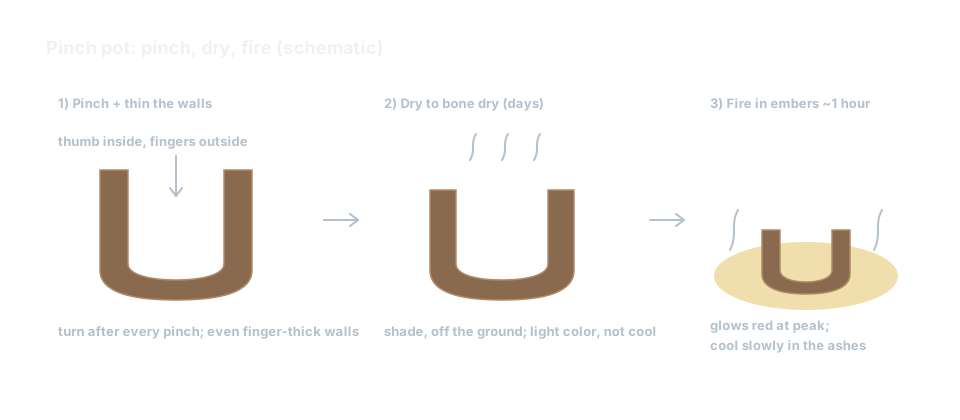
Materials
- A fist-sized ball of prepared clay with sand temper
- Plenty of dry firewood
- A dry, sheltered spot for slow drying (days)
Steps
1) Pinch the pot
- Knead the ball once more, then press your thumb into the center to two-thirds depth.
- Pinch the wall gently between thumb (inside) and fingers (outside) while turning the ball after every pinch.
- Work in spirals from the bottom upward until walls are an even finger-thickness. Thick spots crack; thin spots collapse.
- Press the base gently on a flat surface so the pot stands.
If the clay cracks at the rim while you work, your hands or the clay are too dry — wet your fingers lightly.
2) Smooth
- Smooth inside and out with a wet fingertip or a smooth pebble.
- Close every surface crack now; cracks only grow from here on.
3) Dry — slowly, then completely
- Dry in shade, off the damp ground, for 2 to 4 days (more in humid weather).
- When it reaches bone dry, it is uniformly light in color and no longer feels cool against your cheek.
- Final insurance: stand it near (not in) the fire for an hour, mouth toward the warmth.
Do not rush this step. Almost every burst pot was fired damp.
4) Open-fire the pot
- Build a normal fire and let it burn to a strong bed of embers.
- Warm the pot at the fire's edge, turning it every few minutes, until it is too hot to touch.
- Move the pot onto the embers (mouth down or on its side) and build small dry wood over and around it.
- Bring the fire up gradually to full strength and keep the pot buried in flame and coals for about an hour. The pot should glow visibly red at the height of firing — that glow is what makes the change permanent.
5) Cool slowly
- Let the fire die down on its own with the pot inside.
- Leave the pot in the warm ashes until you can touch it — often several hours.
- Sudden cold (wind, water, cold ground) cracks hot pots; do not pull it out early.
Verification
- A fired pot rings with a sharp tap (a dull thud means underfired or cracked).
- Soak a fired piece in water overnight: it must not soften or smear. (Unfired clay dissolves back to mud.)
- Color has changed through the full wall thickness — snap a test piece to check: no dark raw core.
Safety
- A damp pot in a fire is a small bomb: fragments of spalling clay fly hard and hot. Stand back during the first heat-up, and never lean over the fire.
- Handle the fired pot with green-wood tongs or sticks until proven cool (Make Green-Wood Tongs).
- The pot stays scalding long after it stops glowing.
Troubleshooting
- Pot burst in the fire: it was not bone dry, or warming was too fast. Dry longer; warm at the edge first.
- Cracks while drying: walls uneven or dried too fast; pinch more evenly, dry slower in shade.
- Crumbles after firing / thud sound: never got hot enough — fire bigger, longer, and keep the pot in the hottest zone; or too much fiber temper burned out — use sand temper for pots.
- Pot survives but leaks: open-fired pottery seeps slowly; rub the inside glossy-smooth with a smooth pebble before firing (called burnishing), or accept seepage for non-water uses.
Variants
- Test cups for ore: small thick-walled pinch cups make disposable containers for the charcoal ore test in Find and Test Copper Ore (Field Method).
- Charring vessel: a lidded pot (a second shallow pinch pot as a lid) chars material in low oxygen — see the small-batch variant in Make Charcoal Fuel (Pit Method).
- Coil building: stack and smooth finger-thick clay coils on a pinch-pot base to build taller vessels.